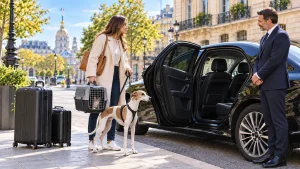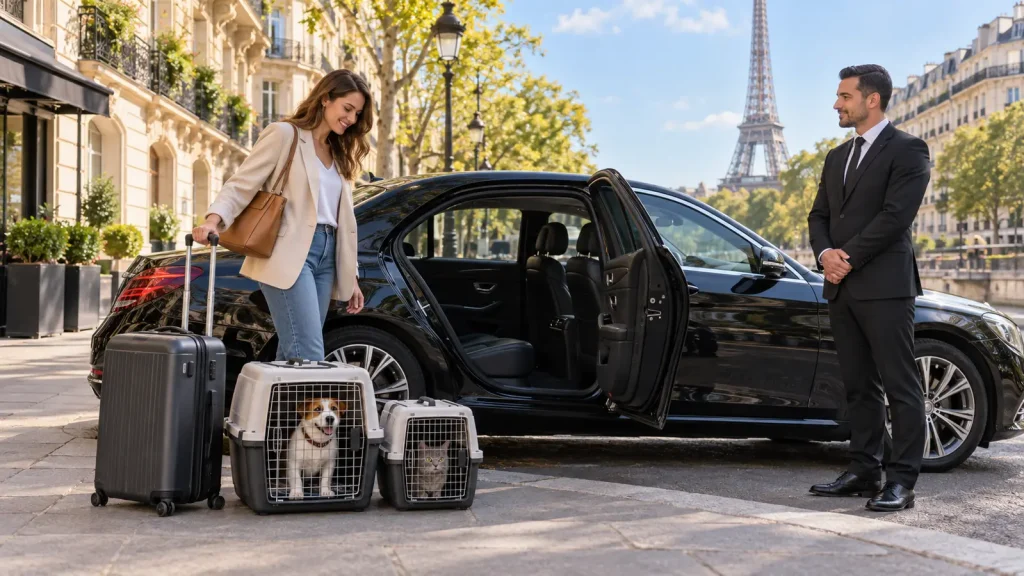
Are you wondering whether you can take an Allocab with a dog, cat or exotic pet? The official answer is yes, subject to certain conditions. Allocab allows pets when they travel in a cage or carrier suited to their size. You must also tell the driver about the animal when booking.
This page explains the known rules for an Allocab ride with a dog, a cat or an exotic pet. It also helps you choose a vehicle when you have a carrier, passengers and luggage. A general private-hire vehicle may suit a straightforward journey, while specialist pet transport is designed for more particular arrangements.
Allocab pets: what are the official rules?
The central rule is simple: a pet may travel in an Allocab vehicle if it is placed in a suitable cage or pet carrier. The container must allow the journey to take place safely while keeping the vehicle clean. Under the conditions published by Allocab, a lead on its own—or holding the animal on your lap—does not replace a carrier.
Passengers must bring their own equipment: the driver does not provide a carrier. It must remain closed. If you do not have a suitable container, the driver may refuse or cancel the journey. You should therefore arrange this before booking.
The second essential rule is to warn the driver. When booking, use the “Message to the driver” field to describe the animal and its carrier. This tells the professional what they will be expected to accommodate and helps them assess the space required. It also reduces the risk of discovering at pick-up that the chosen boot is too small for the actual load.
| Point to check | Information published by Allocab | What to plan before booking |
|---|---|---|
| Container | A suitable cage or carrier is compulsory. | Measure the container and check that it stays closed. |
| Informing the driver | The animal must be declared in “Message to the driver”. | State the species, number of animals and dimensions. |
| Multiple animals | Allowed if each one is contained and the available space permits. | Add up the carriers, passengers and luggage. |
| Assistance dog | Accepted without a cage once the driver has been informed. | Clearly state its status in the message. |
| Pet surcharge | The FAQ reviewed does not mention an extra charge. | Check the price shown for the journey you book. |
At present, Allocab does not advertise a dedicated “Pet” category. You therefore select a standard vehicle category and add the information about your animal. If you are comparing apps, see our guides to Uber Pet, Bolt with pets and G7 with a dog, cat or exotic pet.
How do you book an Allocab with a dog or cat?
Start by entering the pick-up location, destination, date and time. Then choose an available vehicle category that appears suitable for your group and belongings. Before confirming, look for the “Message to the driver” field. This is where you must declare the animal.
A useful message says more than “I am travelling with a dog”. Give specific details, for example: “one 5 kg cat in a 48 × 32 × 30 cm carrier, two passengers and two cabin bags”. For an Allocab with a dog, add the animal’s size, approximate weight and the external dimensions of the cage. For an Allocab with a cat, say whether the container is a rigid carrier or another type of equipment, without assuming that a soft-sided bag will be accepted.
If you are transporting two or more animals, describe every carrier. Wording such as “two cats in two separate carriers, each measuring 50 × 35 × 35 cm” is far more useful. Also mention the number of passengers, checked suitcases, cabin bags, a pushchair or any bulky item. The available space depends on the complete load, not just the animal.
To read the rule at source, see the official Allocab FAQ about travelling with pets. The information on this page was checked on 17 September 2026.
Allocab dogs, cats, pets and exotic animals: which animals are covered?
Travelling with a dog
The dog’s size alone does not determine the right vehicle. The carrier’s external volume is usually the more important factor. A small carrier may sometimes fit alongside luggage in a sedan. By contrast, an assembled carrier for a large dog may require a tall boot, a wide opening or a van. Allocab’s FAQ does not match carrier sizes to vehicle categories, so choosing a van should not be treated as an automatic guarantee that it can be loaded.
Travelling with a cat
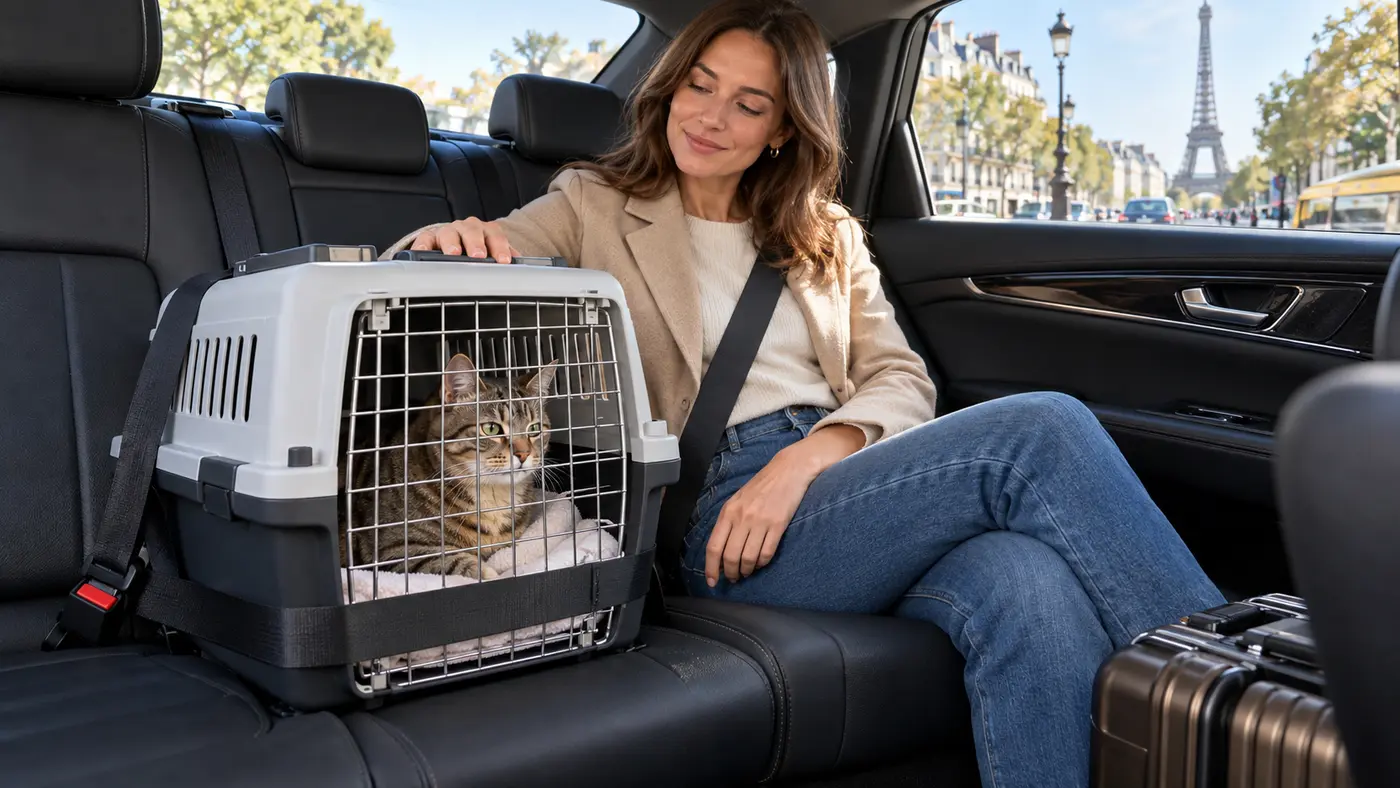
A cat must also be placed in a suitable carrier. Add an absorbent pad and avoid opening the door during the journey, even if the animal meows. A stable, ventilated and properly closed carrier is safer during braking and when car doors are opened. If your cat is anxious or prone to travel sickness, ask your vet for advice beforehand rather than giving it an unprescribed product.
Travelling with an exotic pet
Allocab’s FAQ specifically mentions rabbits, rodents and reptiles among the small animals that may travel in a secure container. However, it provides neither a complete list nor detailed instructions for every exotic pet. For a bird or any species with particular needs, ask for confirmation before booking. Temperature, ventilation, darkness, terrarium stability and journey duration should be planned with a vet where necessary.
Multiple animals and assistance dogs
Several animals may travel if each one is placed in a carrier and the vehicle has enough space. You must therefore declare the exact number of containers. Allocab provides an exception for guide dogs and assistance dogs: they may travel without a cage. Their presence must nevertheless be written in the message to the driver so that the driver can prepare for the pick-up.
Rigid carrier, cage or soft-sided bag: what should you bring?
The official documentation uses the terms “cage” and “suitable carrier”. It does not publish a specific rule for soft-sided bags. It would therefore be unwise to claim that a fabric pet bag is always accepted, even for a small cat or puppy. If you want to use one, ask for confirmation before the journey and provide its actual dimensions.
Measure the length, width and height of the container at its widest points, including handles and wheels. State whether it will travel assembled or dismantled. A dismantled and nested carrier takes up much less room, but it cannot contain the animal during the journey. If the animal must remain inside, only the dimensions of the fully assembled carrier are relevant.
Large airline-style carriers raise an additional question: will they pass through the boot opening or side door? A stated luggage capacity gives neither the usable height nor the access width. Allocab’s FAQ does not provide an official size chart for L, XL or XXL cages or IATA-style carriers. For a large carrier, it is sensible to send the measurements and obtain specific confirmation.
Before leaving, check the fastenings, ventilation and base of the carrier. Add a training pad or absorbent mat without blocking the air vents. Do not fill the inside with heavy objects. A small blanket carrying a familiar scent may reassure some animals, provided it presents no risk of suffocation or overheating.
Allocab sedan or van: which vehicle should you choose with a carrier?
Allocab generally advertises capacity for up to four passengers and three bags in its sedans, and up to six passengers with a stated capacity of seven bags in its van. These figures describe the vehicle categories, but they do not promise that a particular carrier will fit in the boot. A standard suitcase and a rigid cage have neither the same shape nor the same handling constraints.
| Proposed arrangement | Published general capacity | Cautious reading with a pet |
|---|---|---|
| Sedan | Up to 4 passengers and 3 bags. | May suit a small carrier and few belongings once the dimensions have been checked. |
| Sedan with a group | The maximum capacity refers to passengers. | The more seats are occupied, the fewer options there are for arranging carriers and bags. |
| Van | Up to 6 passengers and a stated capacity of 7 bags. | More space overall, with no official guarantee for a large assembled cage. |
| Multiple carriers | Depends on the vehicle actually assigned. | Send every dimension and retain space for the luggage. |
To decide, make an inventory: the dimensions of every carrier, the number of adults and children, checked suitcases, cabin bags, pushchairs and special equipment. An almost empty sedan may be easier than one occupied by four people. A van provides more volume, but its interior layout and luggage compartment may vary.
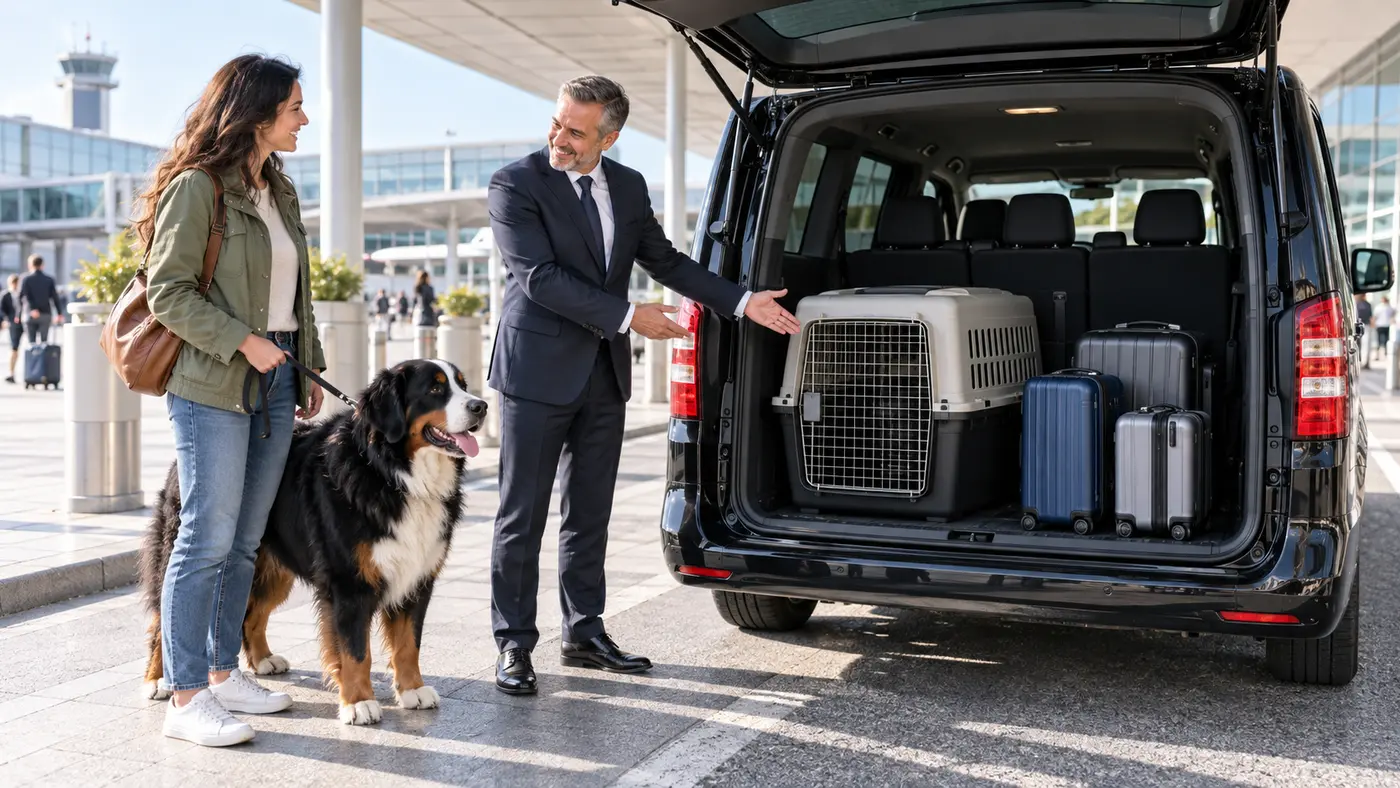
If you are unsure, a service accustomed to handling pet carriers can help determine the vehicle from the exact measurements. Our page about specialist taxi transport for dogs also explains what to check according to the dog’s build and equipment.
Airport, train station, vet or long-distance journeys with a pet
Airport pick-up
After a flight, the total load is often substantial: airline carrier, trolley, suitcases and sometimes several passengers. The meeting time should take account of the terminal, the time needed to collect the animal and, depending on the journey, a visit to the cargo area. Enter the flight number in the booking when the service allows it, but do not confuse flight monitoring with approval of the carrier. To prepare for this situation, see our guide to pet taxis for Paris airports.
Departure from or arrival at a train station
At a station, allow for pedestrian traffic, lifts and the time needed to reach the pick-up point. A rigid carrier quickly becomes difficult to carry with several suitcases. State the train number, time and amount of luggage. Our page about pet transport from train stations describes the useful information in more detail.
Veterinary appointment
A journey to a clinic may be straightforward when a cat or small dog travels with its owner in a carrier. The situation changes if the animal is in pain, recovering from treatment, very anxious or has limited mobility. Describe its condition before departure and ask the vet which precautions are needed. Transport is not a substitute for an emergency veterinary service. For a planned appointment, learn about our pet taxi to the vet.
Long-distance journey
Over several hours, you need to consider breaks, water, temperature control and possible cleaning. Allocab offers journeys over different distances, but its pet FAQ does not publish a particular protocol for breaks or animal monitoring. Clarify the arrangements before confirming. A long-distance pet transport service may be appropriate when the route requires dedicated planning.
Allocab or a specialist pet taxi: which should you choose?
Allocab may be a practical option for an accompanied animal in a suitable carrier, with a straightforward arrangement that has been clearly declared. Booking a standard private-hire vehicle follows a familiar process: journey, time, vehicle category and message to the driver. There is no reason to dismiss this option when it meets the passenger’s needs and the service’s rules.
Specialist pet transport becomes especially relevant when space must be calculated precisely: a large assembled carrier, several animals, substantial luggage, a family group or fragile equipment. It may also suit a complex veterinary appointment, a pick-up in a cargo area or a long journey requiring specific organisation.
Subject to the conditions confirmed when booking, our private-hire and specialist pet transport activity can assess a dog travelling without a cage but with suitable restraint, a cat in a closed soft-sided bag, a large airline carrier, several animals or a pick-up without the owner. These options do not describe Allocab’s rules: they simply make it possible to offer a tailored solution when a general ride does not suit the arrangement.
The most important distinction concerns an unaccompanied animal. The official Allocab page reviewed does not publish a rule stating that a dog, cat or exotic pet may travel alone, without a responsible human passenger. You should not infer that this is possible simply because someone can book a ride for another passenger. For the transport of an animal on its own, ask the relevant service for explicit confirmation or choose a carrier that clearly provides this option.
Likewise, no official “Allocab Pet” category is advertised. The driver receives a standard booking with additional information. With a specialist service, the species, carrier, owner’s presence and any handling needs can be taken into account when the request is first assessed. The right choice therefore depends less on the app’s name than on the actual complexity of the journey.
Checklist before travelling with your pet
A well-described booking reduces unpleasant surprises. Gather the information before choosing the vehicle: a pet carrier is not simply another piece of luggage.
- Note the species, breed or type, approximate weight and number of animals.
- Measure every assembled cage or carrier: external length, width and height.
- Count passengers, checked suitcases, cabin bags and bulky equipment separately.
- Declare the animal in “Message to the driver” before confirming.
- Check that the carrier closes properly and its base is protected.
- Do not assume that a soft-sided bag, large carrier or unaccompanied animal will be accepted without confirmation.
- For an airport or station, add the flight or train number and allow a realistic amount of time.
- Keep useful contact details and the animal’s documents accessible rather than locked in a suitcase.
To estimate the budget for an appropriate solution, see our pet taxi prices. If your arrangement includes an XL carrier, several animals or a journey without an accompanying person, prepare the dimensions and journey details before contacting us.
Have the complete arrangement checked before departure so you can choose a genuinely suitable vehicle.
Request a suitable solution
FAQ about Allocab and pet transport
Does Allocab accept dogs?
Yes, according to its official FAQ, provided the dog travels in a suitable cage or carrier. You must mention the dog in the “Message to the driver” field. Guide dogs and assistance dogs are an exception.
Can I book Allocab with a cat?
Yes. The cat must remain in a suitable, closed carrier during the journey. Bring your own carrier and inform the driver when booking.
Can an exotic pet travel with Allocab?
The FAQ states that a small animal, such as a rabbit, rodent or reptile, may travel in a secure container. However, it does not detail conditions for each species.
Is there an Allocab Pet option?
No official “Pet” category is currently advertised. You must choose a standard vehicle category and then declare the animal in the message to the driver.
Does Allocab charge extra for a pet?
The official FAQ does not mention a pet surcharge; nevertheless, check the displayed price and current terms when booking.
Can I travel with several animals?
Yes, if each animal is placed in a carrier and the vehicle has enough room for the entire load. State the number and dimensions of every carrier.
Is a soft-sided cat carrier accepted?
The published rule refers to a suitable cage or carrier, without specifically addressing soft-sided bags. Ask for confirmation before booking if you want to use this type of container.
Which vehicle category should I choose for a large carrier?
A van generally provides more space, but Allocab does not publish dimensions guaranteeing compatibility with an XL or IATA-style carrier. Send the external measurements before the journey.
Can a pet travel alone with Allocab?
The FAQ reviewed does not publish a rule allowing an unaccompanied animal to be transported. Ask for explicit confirmation or use a service that clearly offers this type of pick-up.
Can a dog travel simply on a lead?
Not under the published general rule: a lead alone does not replace a cage or carrier. Guide dogs and assistance dogs are the exception and may travel without a cage.
Source checked on 17 September 2026. Offers and conditions may change, so consult the official rule before booking.