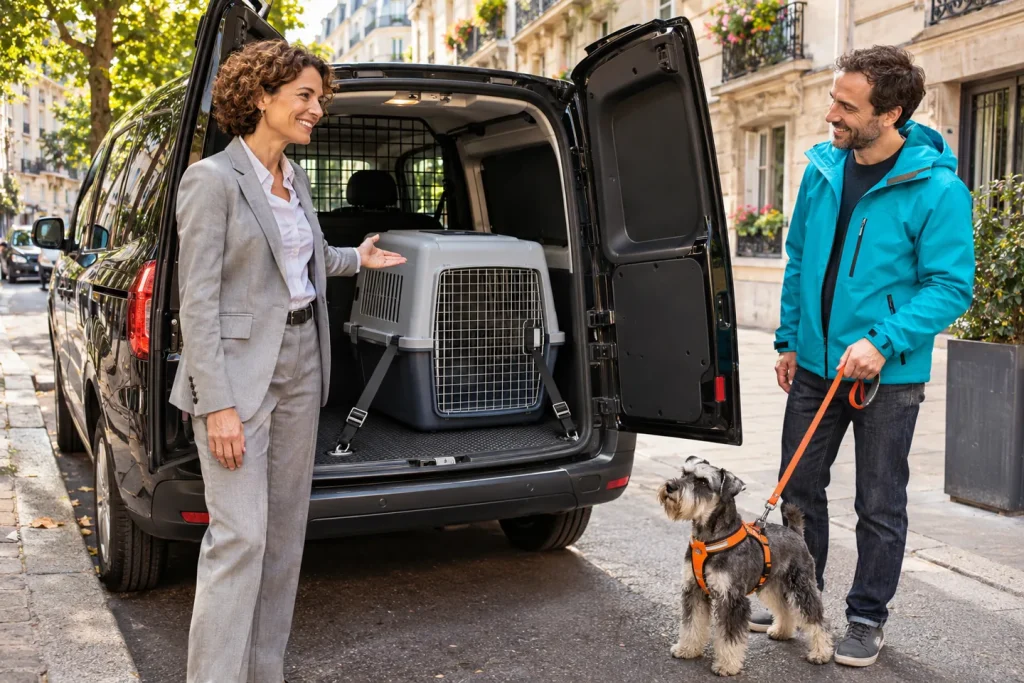
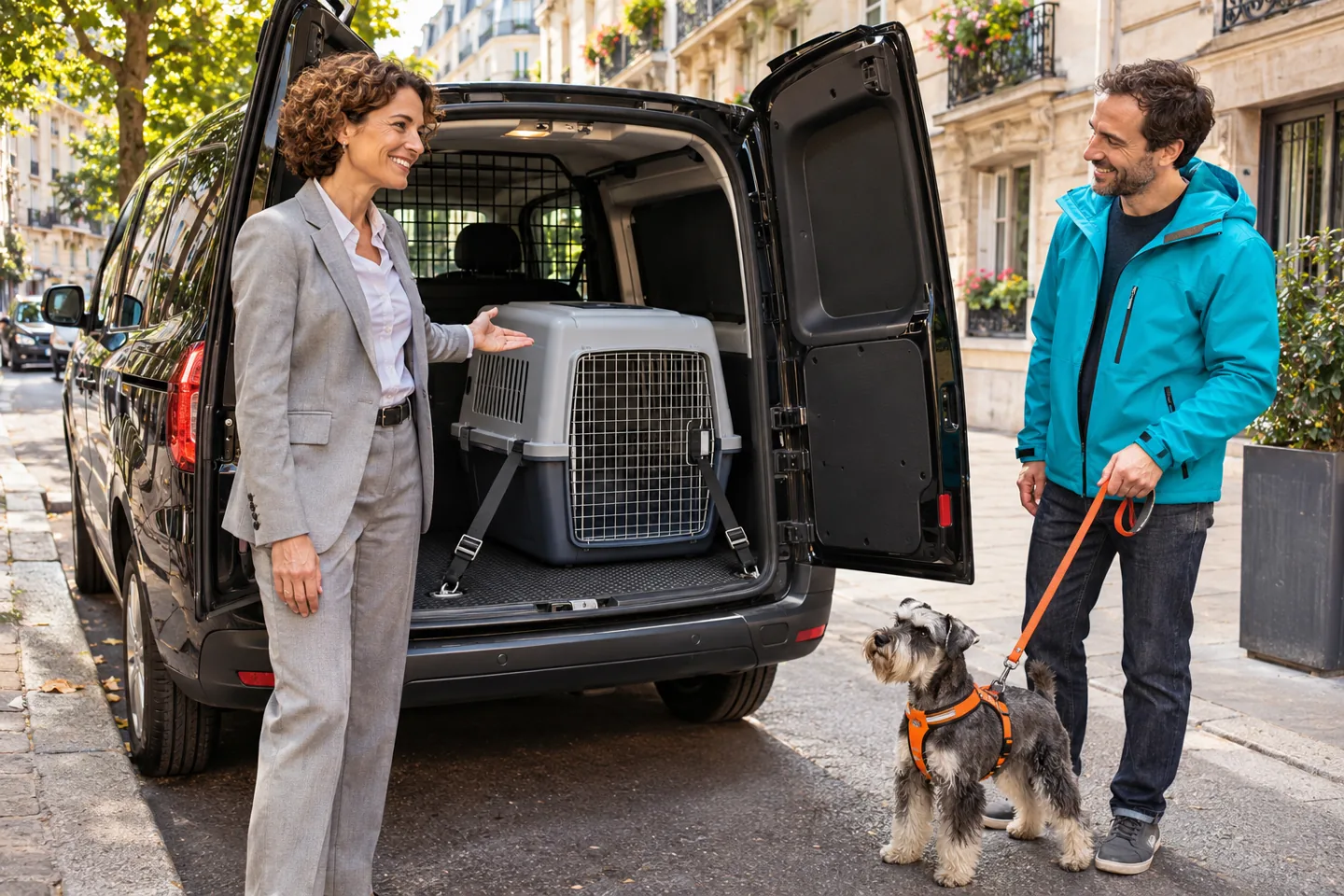
How do you become a pet taxi driver if you love animals and want to work on the road? The job combines driving, journey planning, careful animal handling and communication with owners. Yet a dog travelling to the vet, a cat collected from boarding and a traveller with an XXL crate all require different arrangements.
Here are the steps for developing your project in France, including the important regulatory distinctions and practical questions to resolve before your first bookings. Our pet taxi service in Paris illustrates the needs a new professional may meet.
Regulatory information checked on 25 November 2026. The procedures depend on the exact scope of the activity.


01 · Understanding the daily work
Become a pet taxi driver: what does the job involve?
A pet taxi driver organises and carries out journeys for animals under conditions suited to their needs. The work starts before collection: gathering the right information, choosing a carrier, planning access to the vehicle and identifying who will receive the animal.
The animal travels without its owner
The owner entrusts their companion to you for an appointment, a stay at boarding or a house move. Plan the handover, written instructions and confirmation of arrival. Our dog taxi service illustrates several possible needs.
The owner travels with the animal
Welcoming a person aboard as part of a paid transport service means examining passenger transport regulations. A French VTC private hire activity requires, among other things, a professional driver’s card and the operator’s registration in the relevant register. Animal transport training does not grant these rights.
The term “pet taxi” does not, by itself, give you the rights of a licensed passenger taxi. Define your offer before buying a vehicle: animals travelling alone, owners travelling within an authorised framework, local journeys or longer trips.
Which qualities should you develop?
Patience, punctuality and smooth driving are essential. You also need to understand animal behaviour, work methodically when cleaning and preparing equipment, and reassure worried owners. Working as a pet taxi driver also involves quotations, invoicing and phone calls: you need to be comfortable with that side of the job.
A journey to the vet requires you to know your limits and follow the practitioner’s instructions. Before accepting a vulnerable animal, establish whether it is fit to travel and which precautions are needed.

02 · Choosing the right credentials
Which pet taxi training should you take?
There is no single qualification called “pet taxi driver” that automatically authorises every service. Pet taxi training must match the species carried and the rules applicable to your planned journeys. For dogs and cats, distinguish the individual’s qualification from the business’s authorisation.
Live animal transport training
Live animal transport training, often called TAV in France, covers matters such as fitness to travel, animals’ needs, equipment and transport preparation. For species other than domestic ungulates and poultry, the legislation specifies at least seven hours for one or two comparable categories, with additional training according to the categories added.
ACACED and TAV: what changed in 2025
ACACED is the French attestation of knowledge for domestic companion animals. Attestations issued on or after 1 September 2025 are among the credentials recognised as meeting the transport training requirement for the corresponding categories. A dog ACACED therefore does not automatically cover cats or every species grouped under the French term NAC, meaning other companion animals.
Before paying for another course, show your documents and their issue dates to your departmental DDPP or DDETSPP animal welfare authority. Do not assume an older attestation is equivalent without checking. Recognised credentials are listed in theFrench order on training for drivers and attendants transporting live animals.
Training concerns your skills
Ask the provider for the exact syllabus, categories covered and document awarded. Supplement your pet taxi training with practical experience: closing a carrier, checking a fastening or supporting an anxious dog cannot be learned solely from a document.
Authorisation concerns the transporter
Live animal transport training is not an administrative transporter authorisation. These are two separate parts of the project. If you add boarding, transit or other services, also clarify the obligations specific to those activities.


03 · Organising your launch
How to become a pet taxi driver: the steps to plan
To start a pet taxi business, first write down your services: animals accepted, journey durations, distances, areas served, whether owners may accompany their pets and any additional activities. This document makes discussions with authorities and insurers more precise.
Contact the DDPP or DDETSPP
This departmental authority is your contact for animal welfare questions and transporter authorisation. The applicable requirements vary with the journeys. Where authorisation is required, type 1 covers transport limited to eight hours; type 2 allows journeys exceeding that duration, subject to the corresponding requirements.
The journey time does not automatically reset when the driver changes or at an intermediate transfer. Ask how to calculate the complete journey for your long-distance pet transportproject. The ministry explains the application for a type 1 or type 2 transporter authorisation, the form and its explanatory notes.
The authorisation is valid for a maximum of five years. The ministry recommends allowing around one month for processing after a complete application is received: include this step in your timetable.
Registering the business and choosing its structure
Business registration is handled through France’s single business formalities portal. A sole trader, the micro-entreprise regime or a company: compare the options against your costs, investment and plans. To start a pet taxi business with a financed vehicle and substantial mileage, you need to assess actual expenses before choosing a regime.
An accountant can help you compare scenarios. If you also operate a VTC private hire service, describe both activities in your applications and check that your arrangements allow you to carry them out.
Preparing the documents for each journey
Prepare a form recording, among other things, the animal’s origin, its owner, departure point, destination, departure date and time, and expected journey duration. Add useful contacts, agreed instructions and the identity of the person authorised to receive the animal. This preparation also helps you manage bookings.

04 · Preparing suitable working equipment
Which vehicle and pet taxi insurance should you choose?
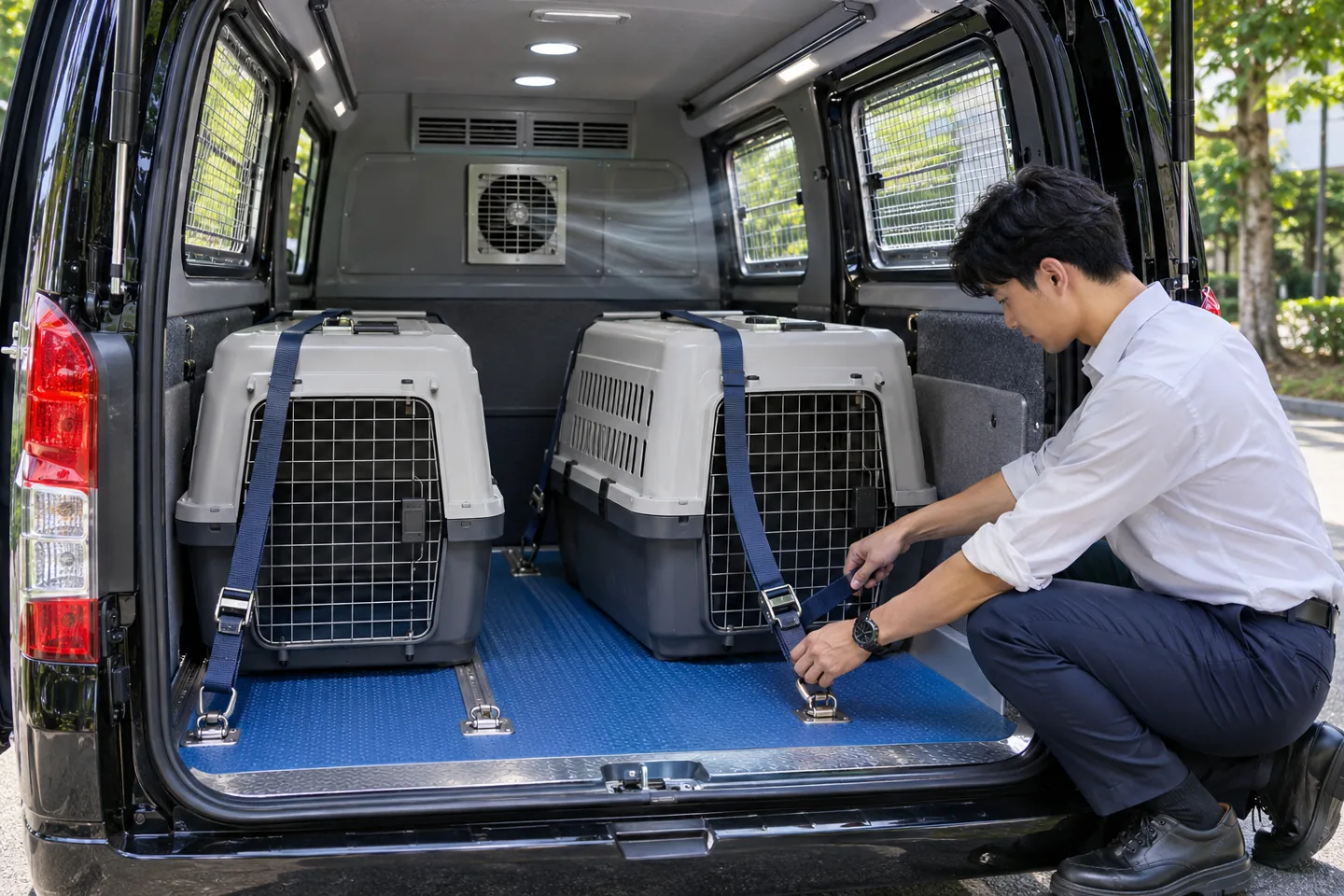
The pet transport vehicle should suit the actual service. For an animal travelling alone, a ventilated cargo van may provide dedicated space. When also carrying passengers within an authorised framework, consider seats, luggage and the vehicle specifications required for passenger transport.
Measure openings, usable height and fastening points before comparing advertised capacities. An assembled crate takes up a different amount of space from two nested halves. The layout must give each animal suitable room and allow supervision.
Equipment to start with
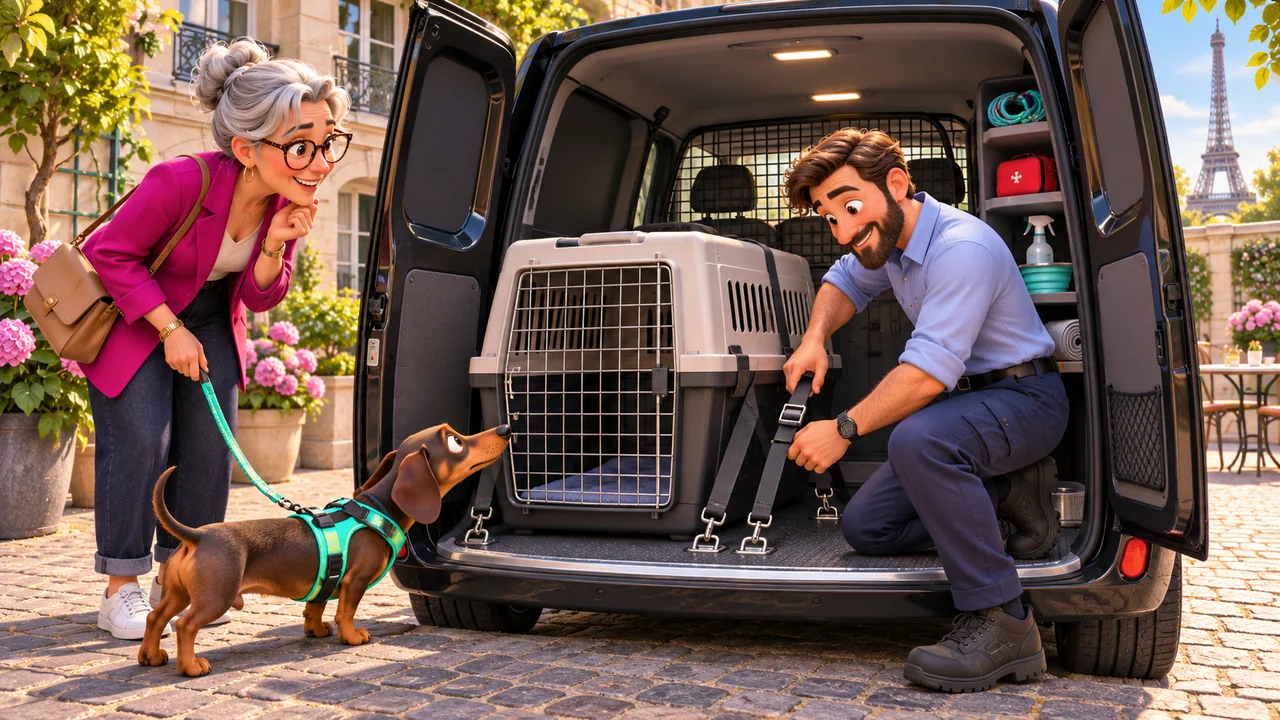
- Ventilated carriers suitable for the animals you accept.
- Secure fastenings, non-slip mats and washable covers.
- Leads and harnesses appropriate for the handling planned.
- Water, bowls and suitable cleaning equipment.
- A charged phone and contact details for the people involved in the journey.
The pet transport vehicle must be easy to clean between bookings. Also plan a procedure for a breakdown or major delay.
Cover to clarify
Ask for pet taxi insurance that explicitly covers professional use of the vehicle and animals entrusted to you. Obtain written details of cover, limits, excesses and exclusions: harm to the animal, escape, incidents during loading or another driver’s involvement.
For a dual activity, pet taxi insurance must be considered alongside cover for paid passenger transport. Describe the exact services to the insurer so the answer matches your business.
Journeys to an airport with an animal may involve bulky crates and several suitcases. Transfers to Paris railway stations require a precise collection plan. These details can influence your choice of vehicle from the outset.

05 · Building a business model
What budget should you plan, and how much does a pet taxi driver earn?
How can you become a pet taxi driver with a realistic budget? Obtain quotations for any training needed, the vehicle, equipment and insurance. Add launch costs and a reserve for the first few weeks. There is no universal starting price: using a suitable vehicle you already own and buying a van are very different projects.
| Cost category | What to calculate |
|---|---|
| Skills and formalities | Any missing training, travel and business start-up support. |
| Vehicle | Purchase or finance, maintenance, energy, parking and equipment. |
| Business protection | Insurance, assistance and arrangements if the vehicle is unavailable. |
| Finding clients | Website, materials, photographs, local visibility and any advertising. |
| Cash reserve | Fixed costs, the launch period and unexpected expenses. |
Turnover, remuneration and salary
A self-employed pet taxi driver’s income depends on business activity and costs. The amount invoiced to a client is not a salary. Approach and return mileage, waiting time, maintenance, social contributions and periods without bookings must be funded before calculating what is available for remuneration.
For an employee, pay depends on the contract and employer. For a self-employed operator, a pet taxi driver’s income should be assessed through a forecast: the number of journeys realistically possible, average booking value and full cost of each service. An earnings promise without these assumptions is not a basis for assessing your project.
Calculating the full cost of a journey
An example of the reasoning, without setting a price: a thirty-minute journey with the animal may require fifteen minutes to reach the collection point, loading time, an empty return trip and cleaning. Your price must fund all that work and a share of fixed costs. See our pet transport prices as examples of how to present prices to clients, then calculate your own costs.
06 · Turning the project into bookings
How do you find your first clients?
Before promising nationwide coverage, identify an area you can serve regularly. Meet local professionals: vets, boarding providers, trainers, groomers and charities. Explain your scope, organisation and collection arrangements, without claiming a partnership before one exists.
A clear page should explain the animals accepted, journeys offered, whether owners can travel and the information needed for a quotation. Our pet transport page for Paris illustrates a service presentation organised around client needs. A well-completed local listing and reviews requested after bookings can support your visibility.
The booking form to prepare
Ask for the date, time, exact addresses, species, breed or type, weight, known behaviour and special needs. For a crate, record the external dimensions and ask whether it stays assembled. If passengers travel as part of your authorised activity, also record their number and luggage. A flight or train number helps you plan the meeting.
Communicate the price and applicable terms before confirmation: waiting time, cancellation, payment, equipment supplied and animal handover. The questions in our FAQ on transporting dogs, cats and other companion animals illustrate owners’ common concerns.
Mistakes to avoid when starting out
- Buying a vehicle before defining your services and checking the formalities.
- Confusing proof of training, transporter authorisation and the right to carry passengers.
- Accepting an animal or journey duration outside your authorised scope.
- Calculating a price using only the kilometres travelled with the animal.
- Promising availability you cannot maintain on your own.

07 · Your action plan
Become a pet taxi driver, step by step
- Define the species, journeys, area and any passengers.
- Have your credentials and project checked by the relevant authorities.
- Complete the necessary training and applicable formalities.
- Register the business and calculate your costs.
- Prepare the vehicle, equipment, insurance and procedures.
- Finalise booking forms and terms of service.
- Build a client base that matches your actual resources.
To become a pet taxi driver, you need an organisation that protects the animal, the client and the viability of the business. Following this order helps you choose useful training, invest in suitable equipment and offer a service you can reliably provide.
Frequently asked questions
How to become a pet taxi driver: useful answers
Is ACACED compulsory to become a pet taxi driver?
Transport alone should not be confused with boarding or transit activities. The credentials required depend on your project. An ACACED issued on or after 1 September 2025 may satisfy the transport training requirement for the categories covered. Have your documents checked by the DDPP.
Is TAV training enough to start?
It may meet the training requirement, depending on the species and credential. It does not replace registration, insurance or a transporter authorisation when required. Nor does it authorise paid passenger transport.
Can you run a pet taxi business under the French micro-entreprise regime?
This regime may be considered, depending on the declared activity and applicable conditions. Compare it with other options, taking account of the vehicle, expenses and your aims. Choosing a regime does not remove professional obligations.
How long does it take to launch?
You need to gather credentials, complete formalities, prepare the vehicle and obtain insurance. Timing depends on your situation and the procedures required. For transporter authorisation, the ministry indicates around one month to process a complete application: allow some extra time.
Can you carry the owner with their animal?
To offer paid passenger transport, you must operate within an authorised framework, such as VTC private hire with its own conditions. An available seat and animal training are not enough. Define this part of the service before advertising it.